

India's Export Potential in Pulses and Grains
- Cybex Exim Solutions
- Oct 31, 2025
- 4 min read

Introduction
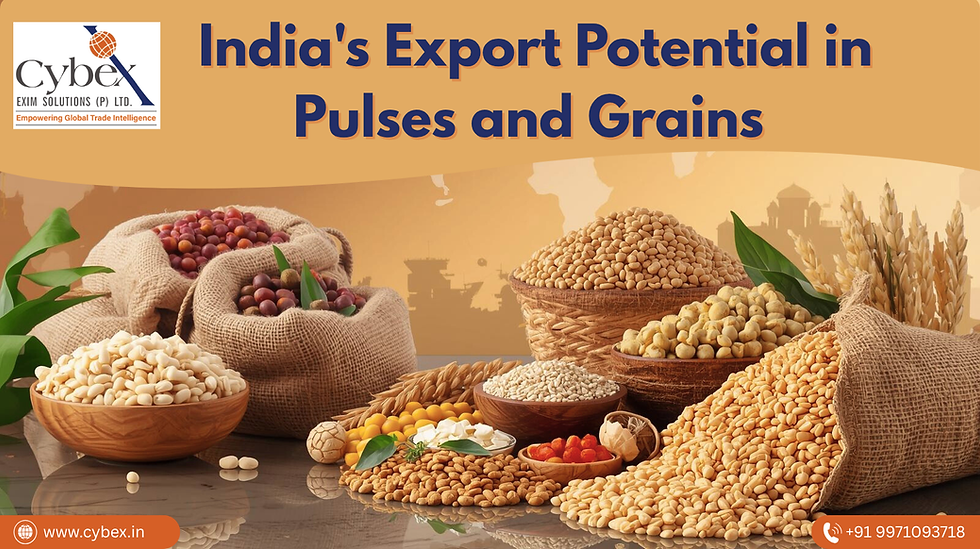
India is currently an agricultural superpower in the world, and the pulses and grains have become a major part of its export. India has been characterized as a land of fertile soils, a diverse range of climatic conditions, sophisticated agricultural practices and hence produces products of superior quality which are equivalent to those in the international markets.
The Pulses and Grains export data shows that India is the favored supplier in the key international markets, and it provides both bulk and value-added products. Exporters who are planning to venture into the world market need to be conversant with these trends to know where to find good markets, link with trusted buyers, and be able to trade well.
Platforms like Cybex Exim Solutions offer real-time trade information and a complete database of exporters to assist businesses in making decisions and optimizing opportunities in the global trade of pulses and grains.
Key Pulses and Grains Exported from India
Agricultural products are the major exports of India in the world, with the export of Rs. 3,18,509 crore (36.95 billion USD) in FY25 (April-December).
Rice is the top export of agriculture, with more than 20 percent of overall agricultural exports, with shipments of Rs. 63,012 crore (USD 7.31 billion) in the period of April to November 2024. Wheat, maize, and barley are the other major grains, and they are heavily bought in the international market.
India is the biggest pulse producer in the globe with 244.93 lakh tonnes of pulse production in FY 2024, but it is also an importer of pulse because of the shortages in the country. Some of the significant pulses that are exported include lentils, chickpeas, pigeon peas, mung beans, and urad dal.
The latest trade data show these pulses and grains are sold to the Middle East, Africa, Southeast Asia, and Europe markets, with a high and increasing demand in the market.
Top HS Codes for Pulses and Grains Export from India
HS Code | Product Name |
10063010 | parboiled rice that is semi-milled or wholly-milled, and can be polished or glazed |
10063030 | semi milled or wholly milled glutinous rice, whether or not polished or glazed |
10063020 | Basmati rice that is semi-milled or fully-milled, whether or not polished or glazed |
10064000 | Broken Rice |
10019910 | Wheat |
10059000 | other maize (corn), excluding seeds |
10082900 | Other millet (excluding grain sorghum and seed for sowing) |
07132000 | chickpeas (garbanzos) |
07134000 | dried shelled lentils, whether or not they are skinned or split |
07136000 | Pigeon Peas (Tur/Arhar) |
07133100 | Black Gram (Urad) / Green Gram (Moong) |
07131000 | dried, shelled peas |
Top Importing Countries for Indian Pulses and Grains
· Saudi Arabia
· Iran
· Iraq
· United Arab Emirates
· Bangladesh
· United States
· Benin
· Nepal
· China
· Vietnam
· Indonesia
· Yemen
Agricultural Export Opportunities in 2025
· High-Demand Products: The international customers are interested in buying specialty rice, organic pulses, and organic grains of high quality. These products are sold at high prices in the global market due to their quality and consistency, as traceability of their place of origin.
· Emerging Markets: In the African countries like Kenya, Nigeria, Southeast Asia like Indonesia and Vietnam, and the Middle East market, there is an increasing market for India export of pulses and grains.
· Value-Added Products: In addition to raw grains and pulses, value-added products, including packaged pulses, processed grains, ready-to-cook mixes, and blended flours, are all becoming increasingly popular outside the US.
· Data-Driven Insights: Trade data will allow the exporter to monitor the performance of their products, observe the quantity of the shipments, and identify the trends across the regions.
· Strategic Planning and Risk Management: Exporters will have access to validated buyer data through an exporter database, which will allow them to plan their shipments properly as well as reduce the dependence on intermediaries.
How Cybex Can Help You Grow Your Export Business
It is hard to grow an export business without the appropriate tools and understanding. Cybex makes this process easier by availing verifiable international buyers and full market information for exporters. This can enable businesses to make sound choices, minimize risks, and have better trade relations.
Cybex allows exporters to know their products' demand in the world market and have a chance to recognize the most promising markets. Companies are in a better position to arrange their delivery, pricing, and market penetration plans and conduct their business much easier and more lucratively.
Cybex also enables exporters to be on top of the game by monitoring industry trends and competitors. This makes sure that the business is able to make strategic decisions leading to growth and attracting emerging opportunities in the international market.
Conclusion
The agricultural export products of India, especially the pulses and grains, offer great opportunity to the businesses that wish to expand internationally. It remains a reliable source of quality agricultural products with a powerful production base, increasing demand in the international market and new markets in Africa, the Middle East and Southeast Asia.
With the help of buyer relationships and market insights, exporters are able to make wise decisions, optimize their shipments, and pursue new business with confidence. Cybex and similar platforms offer the resources and tools necessary to move efficiently into the global trading environment so that businesses find the appropriate buyers and expand their export business in a sustainable manner.
Visit Cybex.in today to access comprehensive trade data and verified buyers worldwide.


Comments